At my Pune flatmate's wedding, her ajoba read the digital invite twice on his phone, looked up, and asked one question: "Muhurta kuthe aahe?" The couple had spent hours on the photo carousel and forgotten to put the muhurta time anywhere above the fold. For a Maharashtrian wedding, that is like printing a train ticket without the departure time.
A Marathi wedding invitation carries a very specific set of expectations. There is a way a lagna patrika is worded, an order in which families are named, and a visual language that everyone in the community recognises instantly, even if nobody can articulate it. Most online invitation builders know none of this.
This is a guide to getting it right: the wording, the events, the colours, and the small details that make an online invite feel like a real patrika instead of a generic card with Marathi names pasted in.
Start with the Paithani palette, not a Pinterest one
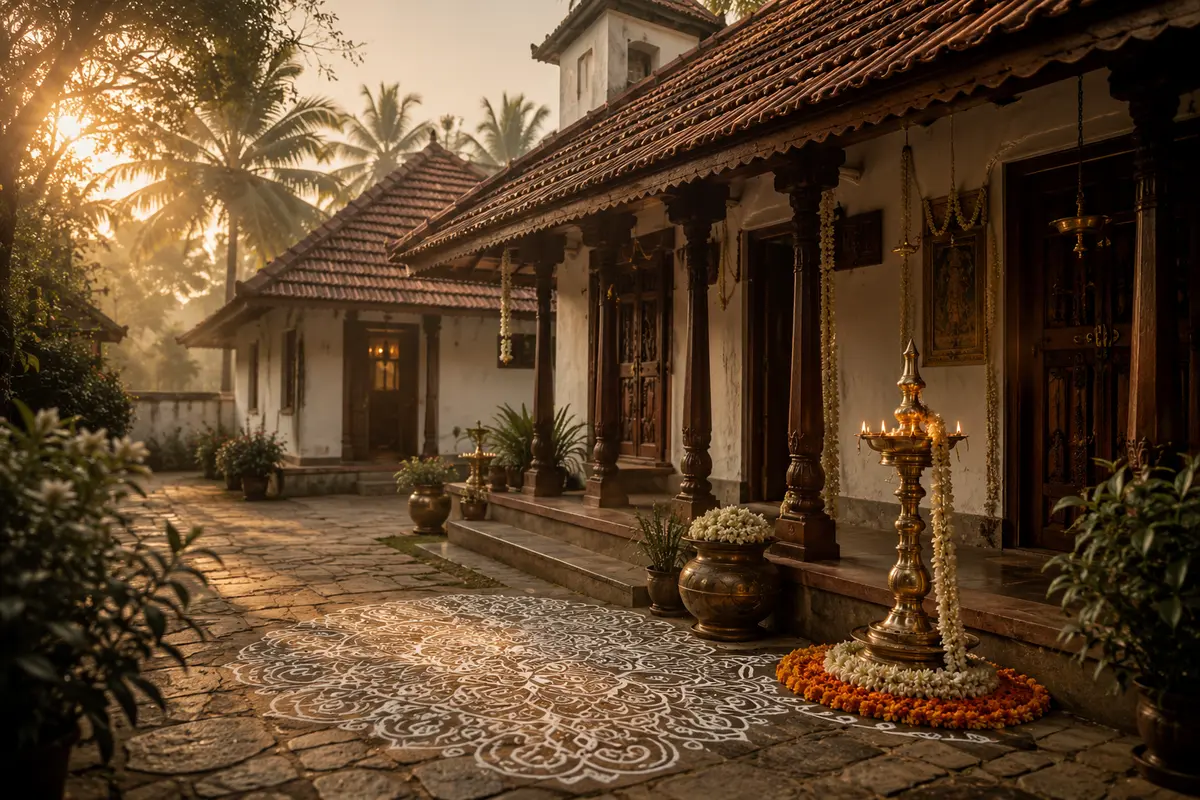
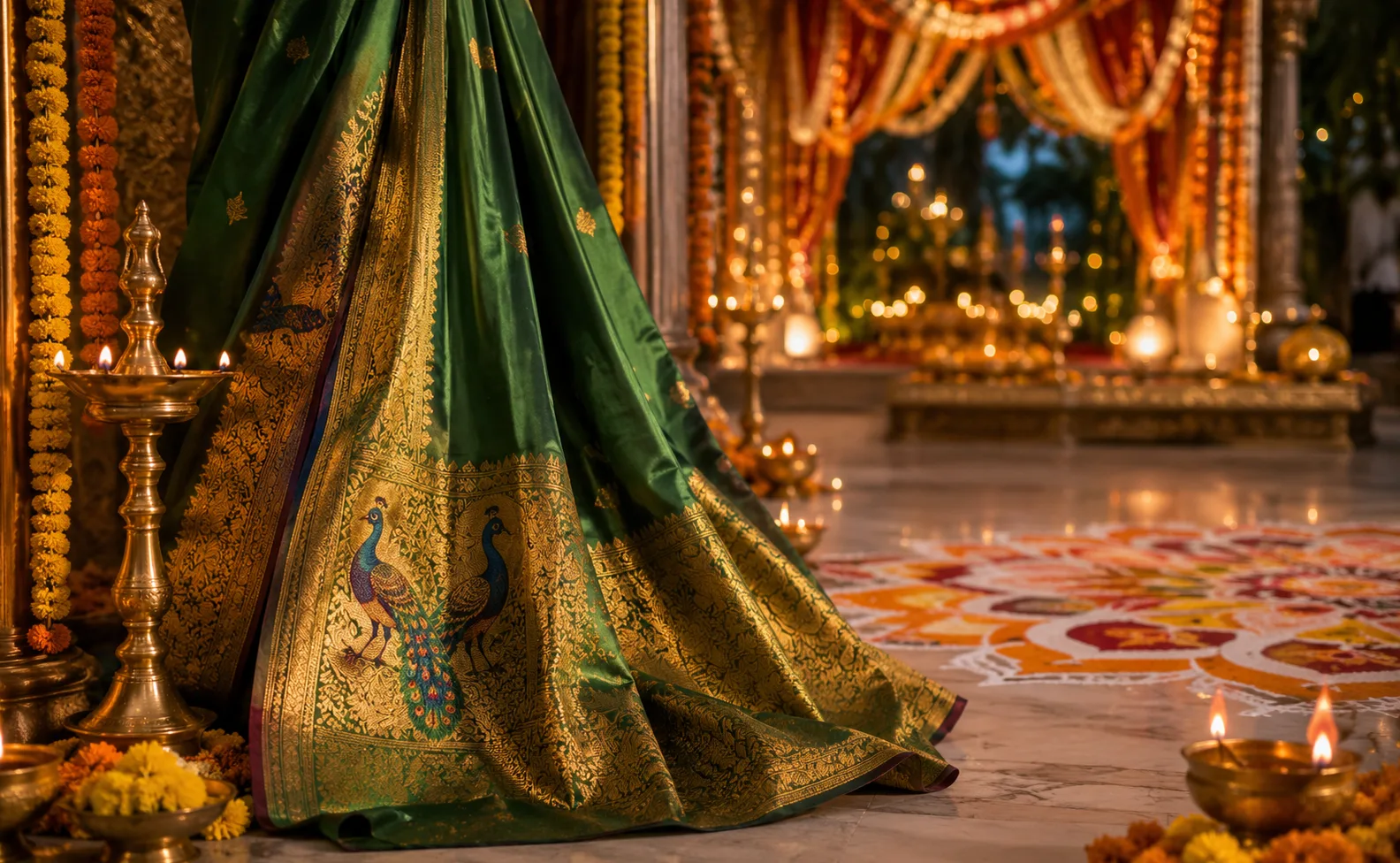
Maharashtrian wedding visuals have their own vocabulary: the deep greens and purples of a Paithani saree, the gold zari border, the mor (peacock) motif woven into the pallu, mundavalya across the forehead, and the clean geometry of a rangoli at the threshold. This is not the red-and-gold of a North Indian wedding, and it is not pastel minimalism either.
If your template starts from a Paithani-inspired base, jewel green with gold and a touch of magenta or purple, the invite looks Maharashtrian before a single word is read. That first-glance recognition matters more than any paragraph you write.
One practical tip: use the mor or the ambi (paisley) motif as an accent, not wallpaper. A single peacock near the couple's names is elegant. Forty peacocks tiled across the background is a bedsheet.
The muhurta goes at the top. Always.
A Maharashtrian wedding runs on the muhurta the way a railway station runs on the clock. Guests, especially elders, will plan their entire morning around it, and many will arrive forty minutes early for the seemant poojan or to watch the mundavalya being tied.
Put the lagna muhurta, date and exact time, in the first screen of your invite, right after the couple's names. Not inside an events accordion, not on a second page. If your grandmother has to scroll to find the muhurta, the design has failed her.
Write it precisely the way the guruji gave it. "Sakal 10 vajun 22 minitani" is not the same as "10 AM onwards", and the family will notice the difference.
Word the patrika like a patrika
A traditional lagna patrika opens with an invocation, usually "|| Shri Ganeshaya Namah ||", and is written from the family, not the couple. The parents and often the grandparents invite you. Something like: "Shri and Sau Deshpande request the pleasure of your presence at the auspicious wedding of their daughter Sayali with Chi. Rohan, son of Shri and Sau Kulkarni."
The honorifics do quiet work here. Chi. (Chiranjeev) for the groom, Chi. Sau. Ka. (Chiranjeev Saubhagyakankshini) for the bride. You do not have to use them, but if your family printed them on your cousin's card, their absence on yours will be read as carelessness, not modernity.
Keep a short Marathi line even if the rest of the invite is in English. "Aapli upasthiti hich amchi shobha" — your presence is our honour — does more for elder goodwill than any design flourish. If your family speaks it, write it.
List the full run of functions, not just the lagna
A typical Maharashtrian wedding is a chain of smaller events: Sakharpuda (the engagement), Kelvan (the pre-wedding family meals), Halad Chadavne (the haldi), sometimes a Grahamakh, then Seemant Poojan, the Lagna itself, and a Reception. Some families add a Satyanarayan Puja after.
Each event block needs its own venue, time, and one-line explanation. Your college friends do not know what a Kelvan is, and your aatya does not need it explained. A line like "Kelvan — a small family lunch before the wedding, immediate family only" serves both audiences without embarrassing either.
Per-event RSVP matters here too. Kelvan is usually family-only, the reception is open. If your invite lets guests RSVP per event, you avoid the awkwardness of politely un-inviting your office team from a twenty-person family meal.
Dress code notes guests actually thank you for
Maharashtrian weddings have looks that guests enjoy participating in: nauvari sarees, nath, shela and pheta for the men. If your sangeet or haldi has a colour theme, or if you would love guests in traditional wear for the lagna, say it plainly on the invite.
"Traditional Maharashtrian attire welcome, nauvari if you dare" reads as an invitation to have fun, not a uniform order. Guests from other communities especially appreciate being told what would be appropriate instead of guessing.
The details that make elders trust the link
Older Maharashtrian relatives are often the most sceptical audience for a digital invite. Three things help. First, the WhatsApp preview must show the couple's names and date, not a blank grey box. Second, the page must open fast on a mid-range phone, because that is what most of the family carries. Third, a phone number for RSVP help, labelled clearly, gives non-tech guests a human fallback.
And keep a downloadable patrika image on the page. Many families still want a card image to forward on the family group or print for the society notice board. A one-tap "Download patrika" button quietly solves the print question without a second design project.
Final Thoughts
The short version: lead with the muhurta, word the patrika from the family with the right honorifics, list every function from Sakharpuda to Reception with per-event RSVP, and let the Paithani palette do the visual work.
ShaadiOra's Paithani Mor template is built on exactly this: the Paithani green-and-gold language, mor motifs used with restraint, muhurta-first layout, and multi-event RSVP. You can preview it and build your own lagna patrika at shaadiora.com/templates. For the matter itself, our wedding invitation wording guide covers the English and Hindi lines in detail.
Frequently Asked Questions
What should a Marathi wedding invitation say first?+
Traditionally it opens with an invocation such as "|| Shri Ganeshaya Namah ||", followed by the family names inviting guests, then the couple's names, and the lagna muhurta with the exact date and time. On a digital invite, keep the muhurta visible on the first screen without scrolling.
Can a lagna patrika be digital instead of printed?+
Yes, and most Maharashtrian families now share the main invite on WhatsApp. Many keep a small printed run for grandparents and the society notice board. A good online invite includes a downloadable patrika image so the same design serves both purposes.
Which events should a Maharashtrian wedding website list?+
The common chain is Sakharpuda, Kelvan, Halad Chadavne, Seemant Poojan, the Lagna, and Reception, with some families adding a Grahamakh or a Satyanarayan Puja. List each with its own venue, time, and a one-line explanation for guests from outside the community.
What colours suit a Marathi wedding invitation?+
The Paithani palette works best: deep green or purple with gold zari accents, and touches of magenta. Peacock (mor) and paisley (ambi) motifs read as Maharashtrian instantly. Avoid the generic red-and-gold North Indian template look and pastel minimalism, both feel off for a lagna.
Aditi Rao
Creative Director
Curating high-aesthetic Indian wedding styling guidelines, tech-enabled RSVP dashboards, and digital invitation designs to make your special wedding day seamless and memorable.