A college friend in Lucknow sent me her nikah e-invite draft for feedback last spring. It was beautiful, deep green, gold calligraphy, elegant type. Her dadi looked at it for a long moment and asked, "Bismillah kahan hai?" The most important line was missing, and no amount of design was going to cover for it.
A nikah invitation has its own grammar. There are lines that open it, an order in which families are honoured, and a tone, formal, warm, unhurried, that guests of every generation recognise. Most invitation builders, designed around a generic "wedding", know none of this.
This is a guide to building a nikah invitation online that gets the grammar right, from the Bismillah to the Walima block, while still being a fast, tappable link that works on every phone in the family group.
Open with the Bismillah, and give it room
Most Muslim wedding invitations open with "Bismillah-ir-Rahman-ir-Rahim", In the name of Allah, the Most Gracious, the Most Merciful, set above everything else, often in Arabic calligraphy. On a digital invite this belongs at the very top of the first screen, unhurried, with space around it.
If you use Arabic script, treat it with care: correct rendering, a calligraphic style like Thuluth or Naskh, never stretched or squeezed to fit. If you are unsure about the script, the transliteration in elegant Latin type is a respectful choice too. What matters is that the line is present and placed with intention.
Some families follow with "Nahmaduhu wa nusalli ala Rasoolihil Kareem" or a short dua. Ask your parents what your family's cards have carried before. This is the one section where you want continuity, not novelty.
The palette: chaandni, not cliché
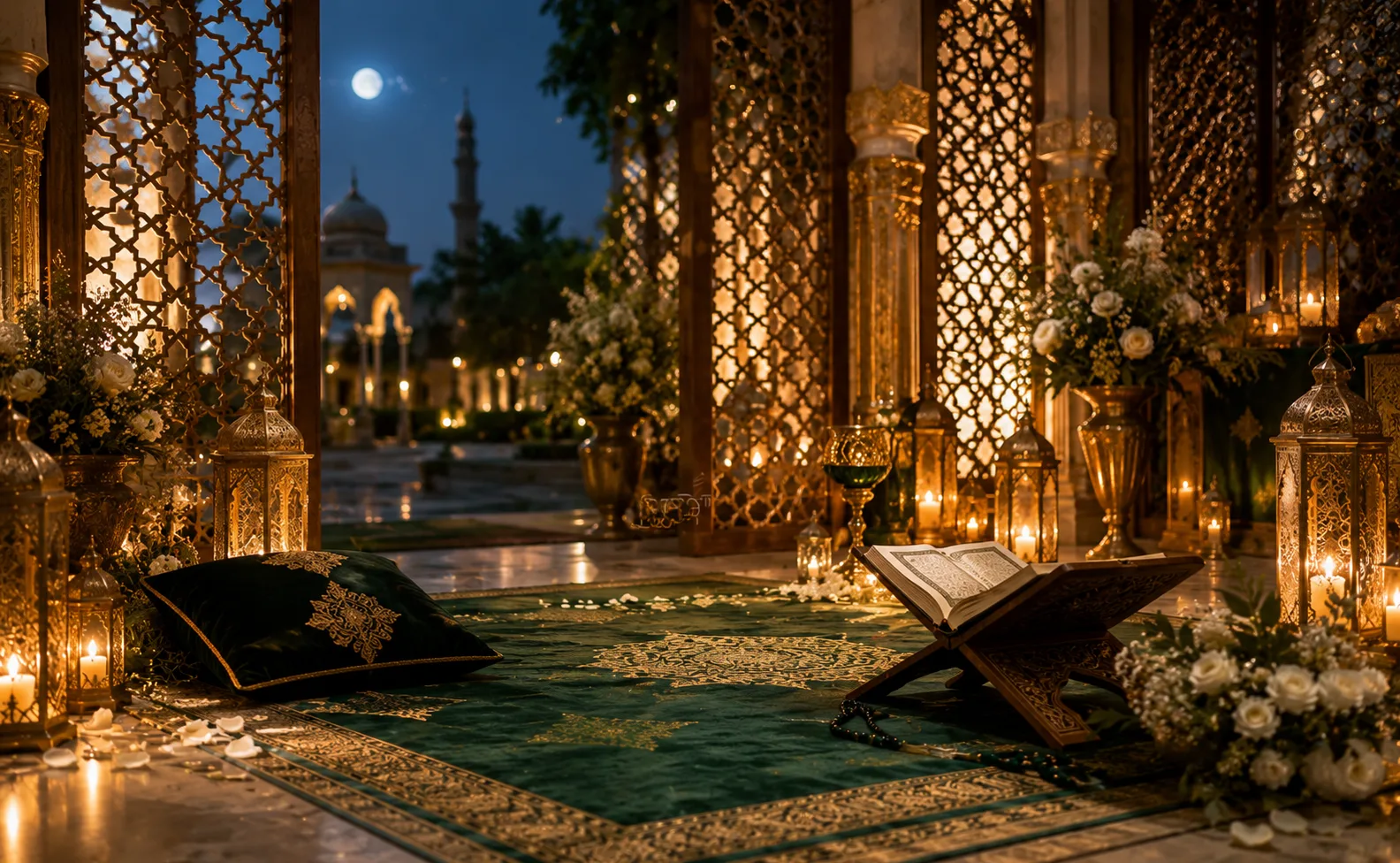
The most graceful Muslim wedding invites lean into a moonlit palette: deep emerald or midnight blue with silver and gold, jaali lattice patterns, Mughal garden motifs, a crescent used subtly if at all. Think of the light at a mehfil after Maghrib, not a stock-art Eid card.
The cliché to avoid is the oversized crescent-and-star treatment. Your invite is not a flag. A jaali border or a paisley-inlay frame says the same thing with far more elegance.
Calligraphy is the jewellery of this design language. One beautifully set line does more than five fonts. Pick a single display face for names and headings and let everything else stay quiet.
Word it from the families, with the duas included
The classic structure holds: the parents invite. "Mr. and Mrs. Syed Ahmed request the honour of your presence at the Nikah ceremony of their daughter Ayesha with Faisal, son of Mr. and Mrs. Khan, Insha'Allah on Sunday, the 21st of December." The "Insha'Allah" before the date is small and essential.
A line requesting prayers lands with every generation: "Aapki duaon ki darkhwast hai", we request your prayers. Many families close with "Dua hai ki Allah is rishte ko mubarak kare." These lines are why elders forward the invite approvingly instead of just noting the venue.
If one side of the family is more formal in Urdu and the other more comfortable in English, write the core matter in English and carry the opening and closing lines in Urdu. Both audiences feel addressed, and nobody needs a translator.
List the events with their own timings, including prayer-aware ones
A full celebration often runs: Mangni (engagement), Mehndi, sometimes a Haldi depending on the community, the Nikah itself, Rukhsati, and the Walima hosted by the groom's family. Each deserves its own block with venue, time, and dress note.
Nikah timings are often set around prayer times, after Asr or after Maghrib is common, and can shift with the maghrib hour. Write the timing the way the family announces it: "Nikah after Maghrib prayers, approximately 6:45 PM" is clearer and more correct than a bare "7 PM".
If prayer arrangements exist at the venue, a mussalla or a designated prayer room, say so on the invite. Out-of-town guests plan around this quietly, and mentioning it is a mark of a host who has thought of everything.
The practical notes that show care
Catering: if the food is halal, guests will assume it; if there are also Jain or vegetarian counters for mixed guest lists, say so in the RSVP form. If your family hosts separate seating for men and women at some events, a gentle note, "Separate seating arrangements at the Nikah", spares guests the awkwardness of asking.
Music: some families keep the Nikah itself without music and bring the daf or soft instrumentals to the Mehndi and Walima. If your invite plays audio on load, match it to the family's comfort, a soft instrumental or nothing at all for the Nikah page is the safer, more graceful default.
And the universal rule: the link must open fast from WhatsApp on an ordinary phone, show a proper preview with names and date, and offer a large RSVP button. Grace is also a page that does not make your khala wait.
Final Thoughts
The short version: open with the Bismillah and give it room, write the matter from the families with the duas your elders expect, list Mangni to Walima with prayer-aware timings, and keep the palette moonlit and restrained.
ShaadiOra's Chaandni Mehfil template was designed around this grammar: calligraphic opening, jaali-and-garden visual language, multi-event blocks with separate RSVP, and a fast link that previews beautifully on WhatsApp. Preview it at shaadiora.com/templates. For the invitation matter, our wedding invitation wording guide has the full playbook.
Frequently Asked Questions
What should a nikah invitation say at the top?+
Traditionally it opens with "Bismillah-ir-Rahman-ir-Rahim", in Arabic calligraphy or elegant transliteration, placed above everything else. Many families follow with a short dua. The invitation matter then comes from the parents, with "Insha'Allah" before the date.
Which events should a Muslim wedding e-invite include?+
Commonly Mangni, Mehndi, the Nikah, Rukhsati, and the Walima, with some communities adding a Haldi. Give each its own block with venue, timing, and dress note, and let guests RSVP per event since the Walima guest list often differs from the Nikah.
How do I write nikah timing if it depends on prayer times?+
Write it the way the family announces it, for example "Nikah after Maghrib prayers, approximately 6:45 PM". This is both more accurate and more respectful than a flat clock time, and out-of-town guests understand the schedule immediately.
What colours work best for a nikah invitation online?+
Deep emerald or midnight blue with silver and gold accents, jaali lattice borders, and Mughal garden motifs. Use calligraphy as the centrepiece and avoid oversized crescent-and-star clip art, which reads as generic rather than graceful.

Aditi Rao
Creative Director
Curating high-aesthetic Indian wedding styling guidelines, tech-enabled RSVP dashboards, and digital invitation designs to make your special wedding day seamless and memorable.