A friend from Jodhpur showed me two wedding invites side by side last year. Both said "royal Rajasthani wedding". One had a jharokha arch framing the couple's names, a safa-clad baraat illustration, and the family's full honorifics. The other had a gold crown clip-art on a maroon background. "This one," he said, pointing at the second, "is what happens when a template thinks royal means shiny."
The Rajwadi aesthetic is one of the most requested wedding looks in India, and one of the most butchered. Real Rajasthani visual language is architectural and specific: jharokhas, mehrab arches, miniature-painting borders, mirror-work textures. Not crowns. Not glitter.
This is a guide to building a royal Rajasthani wedding invitation online that would not embarrass a Jodhpur uncle, whether your venue is a palace in Udaipur or a banquet hall in Borivali.
Royal means architecture, not ornaments
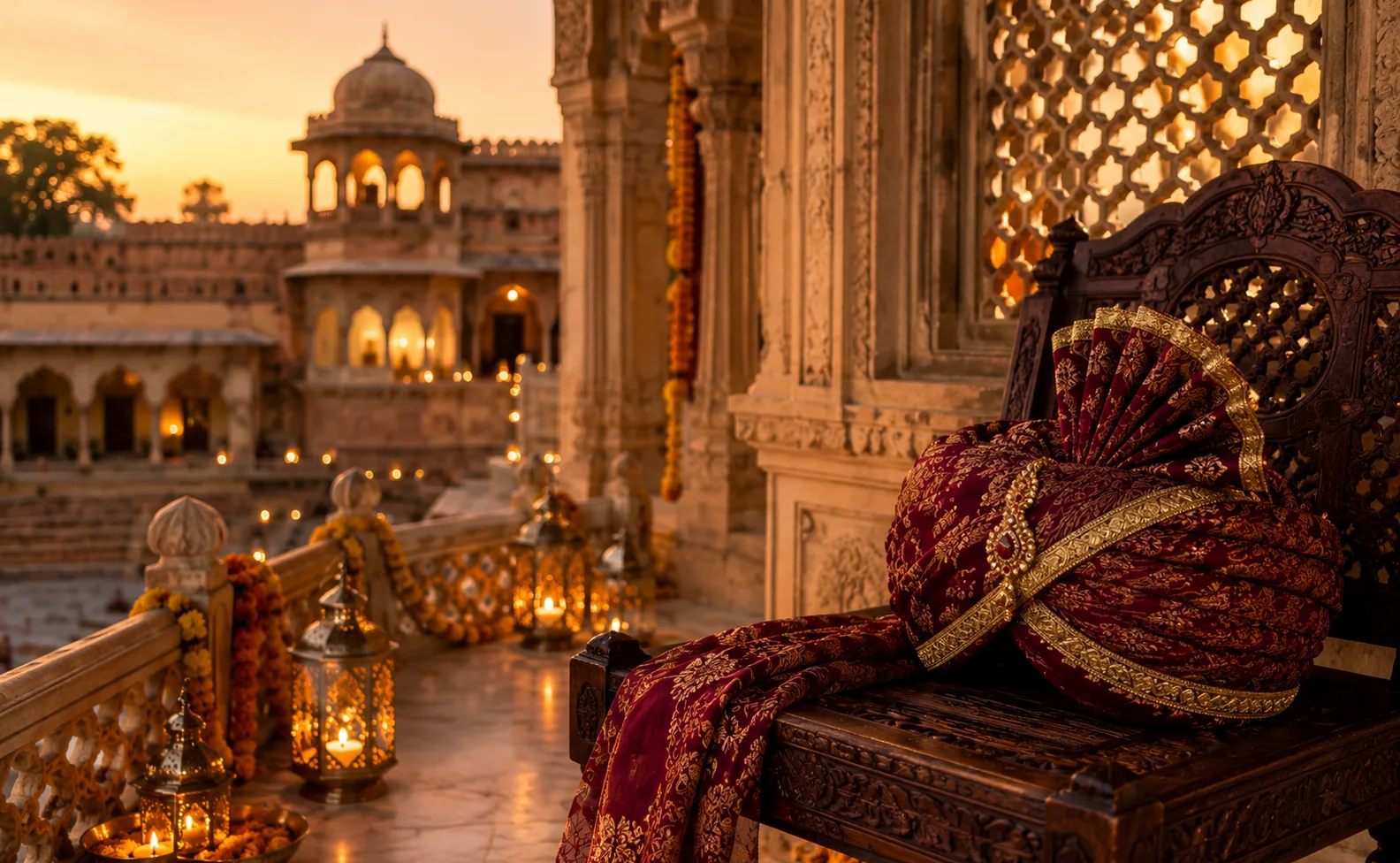
What makes a design read as Rajputana is structure. The jharokha, the carved overhanging window, is the single strongest visual cue, which is why it frames everything from City Palace photo-ops to haveli doorways. Mehrab arches, scalloped edges, and borders drawn from Mewar miniature paintings do the same quiet work.
Colour-wise, think deep maroon and royal blue with real gold, or the sandstone-and-ivory of Jaisalmer with red accents. The mistake is adding more shine: gradients, sparkle overlays, crown emojis. Actual royal design is heavy, matte, and confident.
Hold your template next to a photo of Amer Fort or a Paithani-era miniature. If it looks like it belongs to the same civilisation, you are on track.
Write the family lines the Rajput way, if that is your family
In many Rajput and Marwari families, the invitation presents the lineage, not just the couple. Honorifics like Thakur, Kunwar, and Baisa are not decoration; they carry meaning about family and place. "Thakur Vikram Singh ji and Thakurani Sa request your gracious presence at the wedding of their son Kunwar Aditya Singh" is a sentence with weight.
If your family uses these forms, use them fully and check the spellings with your father before publishing, not after. If your family does not, skip them entirely. Borrowed honorifics read as costume, and the community can tell.
A line of Rajasthani warmth goes a long way with every guest: "Padharo Mhare Desh" as a welcome header tells people what kind of hospitality awaits, whether or not they have ever been to Rajasthan.
List the full sequence: Tilak to Pheras, with the Nikasi
A Rajasthani wedding is a multi-day sequence and your invite should treat it that way: Tilak or Sagai, then Bhaat and Mahira from the maternal side, Pithi Dastoor (the haldi), Mehendi, Sangeet, and on the wedding day the Nikasi, the groom's procession on a decorated ghodi with the safa-tying before it, the Toran ceremony at the entrance, the Pheras, and the Reception.
Guests from outside the community will not know what a Pithi Dastoor or a Toran is. One explanatory line under each event name, "Toran — the groom touches a ceremonial arch at the entrance before the bride's family welcomes him", turns your invite into a friendly guide instead of a schedule.
Per-event RSVP is essential at this scale. The Mahira is family. The Sangeet is everyone. Your invite should know the difference and let guests answer separately for each.
If it is a destination wedding, the invite is also the travel desk
A huge share of royal Rajasthani weddings are destination weddings: palace hotels in Udaipur, forts near Jaipur, havelis in Jodhpur. Which means half your guests are flying or driving in, and their first three questions are about logistics, not the muhurat.
Give the invite a travel block: nearest airport and railway station, a Google Maps pin for the venue, two or three hotel options with rough rates if the venue itself is not hosting everyone, and the WhatsApp number of whoever is coordinating pickups. December nights in Rajasthan drop near freezing while afternoons are warm, and a one-line packing note about that will save your guests real discomfort.
This is exactly what a printed card cannot do and a website does effortlessly. Use the space.
Dress code: give guests a role in the pageant
The joy of a Rajwadi wedding is that guests get to dress the part. Tell them how. "Safas will be tied for all men at the venue before the baraat" is information and an enticement in one line. If the sangeet has a leheriya or bandhej colour theme, put it on the invite with a couple of reference photos.
Be specific about the pheras too. If the ceremony is at night, as many Rajput weddings are, and runs late, say so: "Pheras begin at 11:40 PM; shawls will be provided." Guests plan around honesty.
Sound and restraint
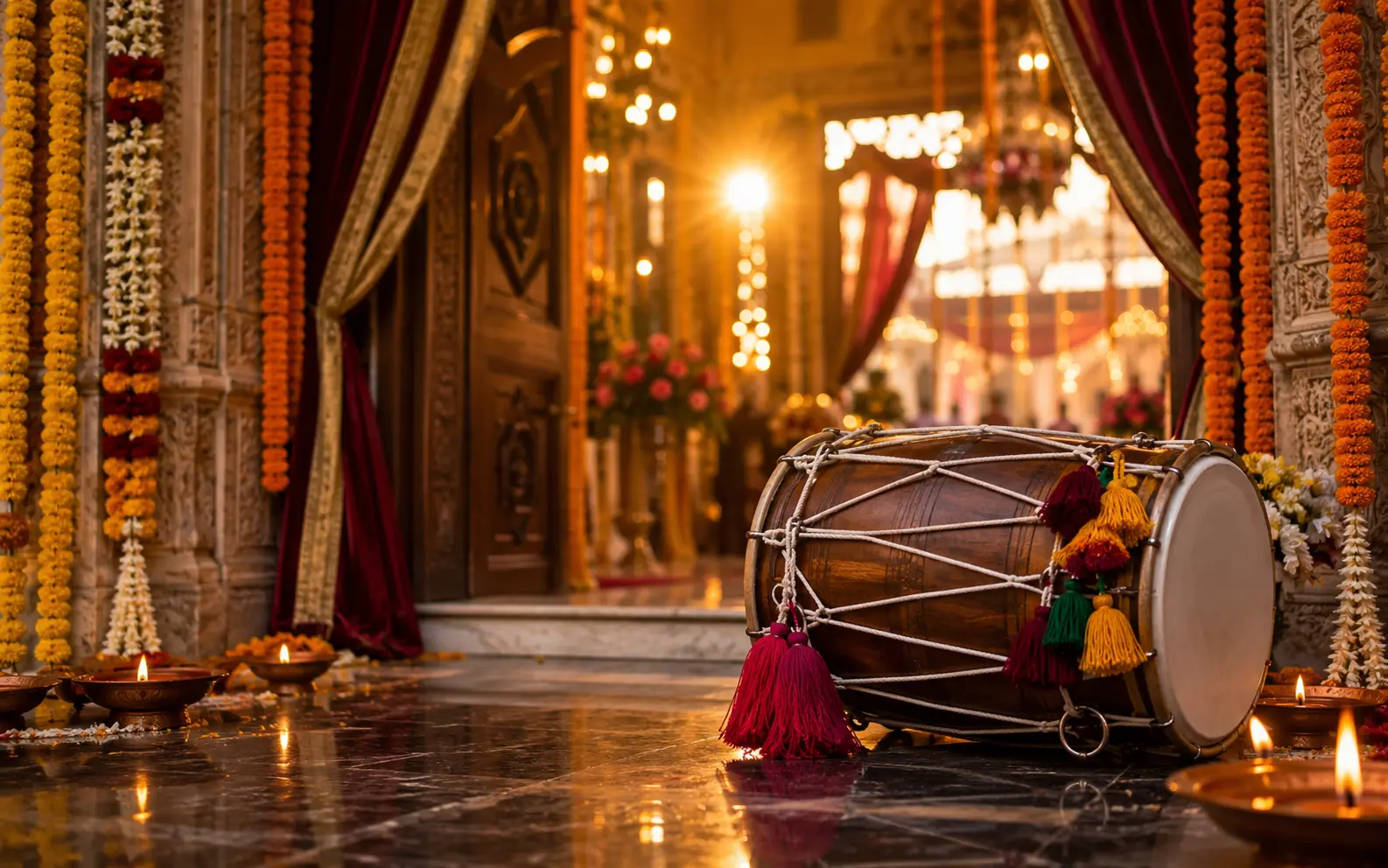
A short shehnai-and-nagada clip on page load sets the darbar mood instantly. Ravanhatta strings, if your template offers them, are even more distinctly Rajasthani. Ten to fifteen seconds, with a visible mute button, is the right dose.
The same restraint applies everywhere: one jharokha frame, one miniature-style border, one gold. The royal look dies by accumulation. Every element you remove makes the remaining ones look more expensive.
Final Thoughts
The short version: build on architecture, not ornaments; write the lineage correctly or not at all; list every event from Tilak to Pheras with per-event RSVP; and if it is a destination wedding, make the invite do the travel desk's job.
ShaadiOra's Rajputana Darbar template was designed on these lines: jharokha-framed layout, miniature-painting borders, multi-day event blocks with separate RSVP, and room for travel details. Preview it at shaadiora.com/templates and build yours in an evening. Then read how to send the invitation on WhatsApp so the sharing goes as smoothly as the design.
Frequently Asked Questions
What makes a wedding invitation look royal Rajasthani rather than generic?+
Architectural elements do the work: jharokha window frames, mehrab arches, and borders inspired by Mewar miniature paintings, in deep maroon, royal blue, and matte gold. Avoid crowns, glitter, and gradient gold effects, which read as costume rather than heritage.
Which events should a Rajasthani wedding invitation list?+
The typical sequence is Tilak or Sagai, Bhaat and Mahira, Pithi Dastoor, Mehendi, Sangeet, then the wedding day with Nikasi, Toran, and Pheras, followed by a Reception. List each with venue, time, and a one-line explanation for guests unfamiliar with the rituals.
What travel details should a destination wedding invitation include?+
Nearest airport and railway station, a Google Maps pin, hotel options with rough rates, the pickup coordinator's WhatsApp number, and a packing note about Rajasthan's cold December nights. A digital invitation handles all of this far better than a printed card footnote.
Should I use Rajput honorifics like Thakur and Kunwar on my invitation?+
Use them if your family genuinely uses them, and verify spellings with elders before publishing. Full, correct honorifics carry real meaning about lineage. Borrowed or half-remembered ones are noticed immediately within the community and read as costume.

Kabir Mehta
Head of Product
Curating high-aesthetic Indian wedding styling guidelines, tech-enabled RSVP dashboards, and digital invitation designs to make your special wedding day seamless and memorable.